

Flight rules
The Club operates under a regime of strict rules whose purpose is two-fold:
- To keep every pilot safe and happy.
- To keep the site open and safe from legal repercussions.
For the benefit of every pilot, we kindly ask you to learn the rules and to respect them.
Licenses and certifications
Section titled “Licenses and certifications”Approved organizations and rating systems
Section titled “Approved organizations and rating systems”The Club formally recognizes the validity of licenses issued by the following organizations:
| Organization | Country | Website |
|---|---|---|
| FAI | International | fai.org |
| APPI | International | flyappi.org |
The Club accepts IPPI Cards and any license that explicitly states the pilot’s IPPI or SafePro rating, regardless of the issuing country or organization.
Your IPPI level may appear on your pilot license as one of these stickers:
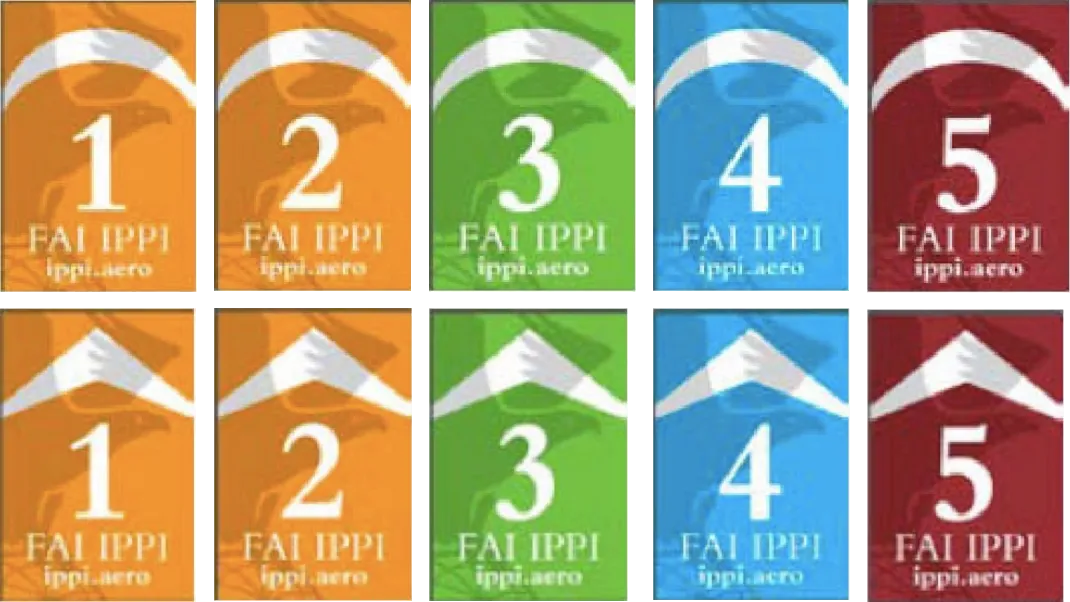
If your license was issued by an organization not included in the list above, and it does not state your IPPI or SafePro rating — and is therefore not formally recognized by the Club — you may petition the Board of Directors at info@clubpenon.org.
Pilot ratings and associated club rules
Section titled “Pilot ratings and associated club rules”Definitions
Section titled “Definitions”- Authorized Guide: A pilot who has been formally authorized by the Club’s Technical Committee to work as a Guide.
- Authorized Instructor: A pilot who has been formally authorized by the Club’s Technical Committee to work as an Instructor, is a current Club Member, and holds a valid membership.
- Authorized Tandem Pilot: A pilot who has been formally authorized by the Club’s Technical Committee to work as a Tandem Pilot, is a current Club Member, and holds a valid membership.
- Club Member: A pilot accepted as an Associate during a General Assembly of the Club.
- Responsibility: Instructors and Guides assume responsibility for their student’s safety by co-signing their Release of Liability form, and are expected to supervise them at all times.
Pilots flying solo
Section titled “Pilots flying solo”Without license
Section titled “Without license”- You must fly under the Responsibility of an Authorized Instructor.
- The Authorized Instructor is responsible for evaluating your skill rating and ensuring that you follow the corresponding rules.
IPPI 1, APPI 1
Section titled “IPPI 1, APPI 1”- You must fly under the Responsibility of an Authorized Instructor.
- You must fly with a red ribbon clearly visible to other pilots.
- From November 1st to June 1st: you cannot fly between 11 am and 4 pm.
IPPI 2, APPI 2
Section titled “IPPI 2, APPI 2”- You must fly under the Responsibility of an Authorized Instructor or Authorized Guide.
- You must fly with a red ribbon clearly visible to other pilots.
- From November 1st to June 1st: you cannot fly between 11 am and 4 pm.
IPPI 3, APPI 3
Section titled “IPPI 3, APPI 3”Rules differ for visitors and local pilots:
- Visitor: You must fly under the Responsibility of an Authorized Instructor or Authorized Guide.
- Club Member: No restrictions.
IPPI 4, APPI 4 · IPPI 5, APPI 5
Section titled “IPPI 4, APPI 4 · IPPI 5, APPI 5”- No restrictions.
Pilots flying tandem
Section titled “Pilots flying tandem”Without license
Section titled “Without license”- You are prohibited from flying tandem.
IPPI 5, APPI 5
Section titled “IPPI 5, APPI 5”- You must fly under the Responsibility of an Authorized Instructor.
- Your passengers must hold a minimum certification of IPPI 2 or APPI 2.
- You are prohibited from charging passengers.
APPI Non-commercial Tandem “In Progress”, or equivalent
Section titled “APPI Non-commercial Tandem “In Progress”, or equivalent”- Your passengers must hold a minimum certification of IPPI 2 or APPI 2.
- You are prohibited from charging passengers.
IPPI 6, APPI Non-commercial Tandem, or equivalent · APPI Commercial Tandem, or equivalent
Section titled “IPPI 6, APPI Non-commercial Tandem, or equivalent · APPI Commercial Tandem, or equivalent”- Visitor: You are prohibited from charging passengers.
- Authorized Tandem Pilot: You are permitted to charge passengers.
Tandem license from the Club de Vuelo y Vela de Valle de Bravo
Section titled “Tandem license from the Club de Vuelo y Vela de Valle de Bravo”You can fly solo as well as fly non-commercial tandems without having to pay the entrance fee. To fly commercial tandems you must become a Club Member, hold a valid membership, and be formally authorized by the Club’s Technical Committee.
Pilots giving instruction
Section titled “Pilots giving instruction”Only Authorized Instructors are allowed to give instruction to student pilots who do not hold a license or hold a license with an IPPI 1 or equivalent rating.
Pilots guiding other pilots
Section titled “Pilots guiding other pilots”Only Authorized Guides are allowed to guide pilots who hold a license with an IPPI 2, IPPI 3, or equivalent ratings.
If you are not an Authorized Guide you are only permitted to guide pilots who are allowed to fly without supervision; see Pilots Flying Solo.
Flight-related rules
Section titled “Flight-related rules”Mandatory equipment
Section titled “Mandatory equipment”- Helmet
- Reserve parachute
- Radio
Turning direction
Section titled “Turning direction”For the safety of every pilot in the air, the Club imposes a turning direction in the entire Peñón area, and especially in the house thermal and around launch.
- On even days: turn to the right.
- On odd days: turn to the left.
Restricted hours
Section titled “Restricted hours”From November 1st to June 1st, between 11 am and 4 pm, some flight restrictions apply; see Pilot ratings and associated club rules.
Top landing
Section titled “Top landing”Top landing is prohibited in December and January.
Top landing is prohibited on tandem flights all year; see Fines and sanctions.
Solo pilots may top land:
- From February to November, and
- When no pilot is waiting to launch.
The pilot attempting the top landing bears sole responsibility in case of an accident.
Kiting
Section titled “Kiting”The Club allows kiting (ground handling) in the landing zone under the following conditions:
- Pilots on approach always have priority. Pilots who are kiting must watch for anyone on final or on approach at all times, and must bring their wing down and give way immediately.
- The landing zone is first and foremost for landing. Kiting is a secondary activity and must not interfere with flight operations.
- Safety is non-negotiable. Any pilot who, through omission or negligence while kiting, puts others at risk will face disciplinary action.